Compliance AI
Audit-ready AI compliance in minutes, not months
Continuous compliance starting with 5 key frameworks (Professional) and scaling to 50+ regulations across 22 jurisdictions (Business+). Auto-discovers AI systems, generates model cards and Annex IV docs, pulls live control evidence from 16+ connectors, manages training programs, handles EU AI Act Article 73 incident reporting, and typically produces audit-ready reports in under 20 minutes.
The Problem
AI regulations are accelerating — the EU AI Act is live, ISO 42001 is being adopted globally, and new national AI laws are appearing across jurisdictions at a rate that makes manual tracking unsustainable. Your board wants an AI risk report, your auditors want evidence trails, and your compliance team is drowning in spreadsheet work. Meanwhile, shadow AI deployments — systems your team never officially approved — are being added every week, expanding your regulatory surface area invisibly. Studies routinely find organizations have 3 to 5 times more AI systems in production than their compliance teams know about.
The Solution
Compliance AI covers 8 capability areas in a single platform: AI system registry with model card generation, live infrastructure control testing via 16+ connectors, training management with immutable completion evidence, incident management with EU AI Act Article 73 authority notification tracking, regulatory intelligence from a daily AI-triaged feed, OSCAL and GRC data export, a customer-facing Trust Center, and evidence approval workflows with DPO/CISO sign-off. Most organizations reach compliance-ready status in under 14 days. Audit reports are typically generated in under 20 minutes — not 6 weeks.
AI System Registry & Model Cards
The AI System Registry captures rich metadata for every AI system in your organization: lifecycle stage, owner, data sensitivity classification, agentic properties, and multi-jurisdiction risk classification across EU AI Act, ISO 42001, NIST AI RMF, HIPAA, and GDPR Article 22. Model Cards are LLM-generated and versioned — each card captures intended use, training data provenance, known limitations, and performance metrics in a structured format. Cards can be exported as PDF, JSON, or HTML. Annex IV technical documentation required under EU AI Act Article 11 is auto-generated from registry data, eliminating a task that previously took compliance teams weeks of manual drafting.
Shadow AI Discovery
Discovery surfaces AI systems that teams have not self-reported, including employee-adopted SaaS tools and internal ML pipelines not registered in IT asset management. Auto-discovery typically uncovers 3 to 5 times more systems than manual inventories capture.
Live Infrastructure Control Testing
Compliance AI connects to 16+ live infrastructure sources to pull and test controls — not just collect logs.
Cloud IAM & Identity: AWS Config, AWS IAM, Azure AD, GCP IAM, Okta, OneLogin
Source Control & CI/CD: GitHub, GitHub Actions, GitLab CI, CircleCI, Jenkins
Observability & SIEM: Splunk, Datadog, New Relic
HR Systems: BambooHR, HiBob
Custom Sources: Generic Webhook for any system not natively supported
Each connector tests specific controls mapped to regulatory requirements — for example, AWS IAM evidence maps to EU AI Act Article 9 (risk management) and ISO 42001 clause 8.4 (risk treatment). Evidence is collected continuously and stored in an immutable audit trail with full chain of custody.
Training Management
Training programs can be delivered as SCORM 1.2, SCORM 2004, xAPI, or read-acknowledge formats, enabling integration with any existing LMS or delivery directly through TruthVouch. Role-based targeting assigns programs to specific job functions — EU AI Act Article 14 requires human oversight training for operators of high-risk AI systems; ISO 42001 clause 7.2 requires competence documentation. Auto-assignment rules enrol employees automatically when they are added to a role or when a new regulatory obligation requires training. Recertification intervals enforce periodic re-completion for ongoing compliance.
Completion evidence is stored with a SHA-256 content hash of the training material at time of completion, making it cryptographically verifiable that the employee completed the current version of the course. xAPI ingest accepts completion records from external LMSs (Cornerstone, Workday Learning, and others), consolidating evidence in one place without requiring migration. A needs assessment tool maps current team competencies against regulatory requirements to identify gaps before an audit surfaces them.
Incident Management
Compliance AI manages the full incident lifecycle from initial report through to closure: reported → investigating → authorities_notified → resolved → closed. EU AI Act Article 73 requires providers and deployers of high-risk AI systems to notify the relevant national competent authority within 3 days of a serious incident and within 15 days for other significant incidents — these deadlines are automatically calculated and tracked per jurisdiction from the moment an incident is classified.
Anonymous whistleblower reporting is supported, allowing internal reports without identifying the reporter. Each incident record links to related compliance evidence and open obligations, giving investigators immediate context. Authority notification tracking records which jurisdiction has been notified, when, and by whom — note that actual notification dispatch is performed manually by your compliance team; TruthVouch tracks status and sends reminders, but does not send notifications on your behalf. Deadline reminders are sent at 90, 60, 30, 14, 7, 3, and 1 day before each notification deadline.
Regulatory Intelligence Feed
A Hangfire-scheduled scraper runs daily against EUR-Lex, RSS feeds, and regulatory authority websites to detect new and amended AI-related regulations. A Python AI triage layer classifies each update by urgency, change type (new regulation, amendment, guidance, enforcement action), jurisdiction, and risk tier before it reaches your team. Updates enter a SuperAdmin review queue where they are confirmed and enriched before being published to tenants — ensuring you never receive raw, unvalidated regulatory noise.
Digest emails summarise weekly regulatory developments across your active jurisdictions. An on-demand trigger lets you pull a fresh feed at any time, outside the daily schedule. Coverage includes EU AI Act amendments, ISO standards updates, national AI laws, and sector-specific guidance across financial services, healthcare, and critical infrastructure.
Compliance Data Export & GRC Integration
OSCAL 1.1 Exports
System Security Plan (SSP), Assessment Results, and Plan of Action & Milestones (POA&M) are all exportable in OSCAL 1.1 format, enabling direct import into GRC platforms and federal compliance toolchains.
Audit Trail
Every compliance event is appended to an NDJSON audit trail in WORM (Write Once Read Many) format — immutable, append-only, and suitable for evidentiary use. Board-level compliance reports are generated as PDFs with executive summaries, risk heat maps, and control status dashboards.
GRC Outbound Sync
Compliance findings, open obligations, and control gaps are synced bidirectionally to ServiceNow and Jira. Status changes in either direction are reflected in both systems within minutes. Model Card PDFs and evidence packages can be attached to GRC tickets automatically.
Customer Trust Center
The Trust Center gives your customers a configurable public-facing page showing your compliance posture — audit scores, framework coverage percentages, and certification status — without exposing raw evidence artifacts or internal documentation. Access modes are fully configurable: public (no authentication), password-protected, email-capture, or invite-only for enterprise customer portals.
Each Trust Center has a configurable URL slug. An embeddable JavaScript badge and SVG badge let you display compliance scores on your own website or product UI. Access logs record every visitor, their access tier, and timestamp; lead notifications alert your sales team when a new prospect views the page. The Trust Center is designed to accelerate vendor security reviews and procurement approvals by giving buyers self-serve access to your compliance evidence summary.
Policy Exception & Deviation Workflow
What happens when a control cannot be met? Compliance teams can formally request an exception to any policy — documenting the justification, the risk accepted, and the compensating controls in place. Each exception request goes through an approval workflow: reviewers can approve or reject with a documented rationale, creating a full audit trail of every exception decision. Approved exceptions carry an expiry date and auto-expire when that date passes — after which the underlying control requirement re-activates automatically. The audit trail captures every state transition, approver identity, and rationale, making the exception lifecycle defensible under scrutiny from internal audit or external regulators.
Per-Policy Review Reminders
How do you ensure policies stay current? Each policy can be configured with a recurring review schedule — daily, weekly, monthly, quarterly, or annual. The system sends automated email reminders to the policy owner before the review due date, prompting them to re-examine the policy for continued accuracy and relevance. When a review is completed, the reviewer marks it done and can attach evidence — updated control test results, sign-off documents, or notes — creating a documented review history per policy.
Authority Notification Dispatch
How does TruthVouch help with mandatory regulator notifications? When an incident triggers a regulatory notification obligation, Compliance AI auto-generates a structured draft notification from the incident record. EU AI Act Article 73 imposes a 15-working-day deadline for serious AI incidents; GDPR Article 33 imposes a 72-hour deadline for personal data breaches. Both deadlines are calculated and tracked from the moment the incident is classified. Draft notifications go through a review and approval step before dispatch — ensuring your compliance team verifies accuracy before anything leaves the organisation. A deadline alert job runs continuously and notifies the team when a statutory deadline is approaching, reducing the risk of a missed notification.
Supported Notification Frameworks
The following statutory notification frameworks are tracked and draft-generated:
- EU AI Act Article 73 (serious AI incident notification to market surveillance authority)
- GDPR Article 33 (personal data breach notification to data protection authority within 72 hours)
DPIA and Algorithmic Impact Assessment
When is a Data Protection Impact Assessment required? GDPR Article 35 requires a DPIA before processing that is likely to result in a high risk to individuals — including AI systems that make automated decisions about people or process special category data at scale. EU AI Act additionally imposes algorithmic impact assessment obligations for high-risk AI systems. Compliance AI auto-generates DPIA and algorithmic impact assessment drafts from the AI system registry data — pulling in system purpose, data categories, retention periods, risk classification, and existing controls — and then uses LLM-assisted generation to produce a structured assessment document aligned to the applicable standard.
DPIA Workflow
The generated draft enters a DPO sign-off workflow: the DPO reviews the assessment, can request revisions, and formally approves or rejects it. Every revision cycle is preserved as a version snapshot, creating a complete version history of the assessment from initial draft through to signed approval. Completed assessments can be exported as PDF (for auditor submission and data subject rights documentation) or JSON (for GRC platform import). Rejected DPIAs automatically generate a linked remediation task to address the identified gaps.
Linked Remediation Tasks and POA&M
How are compliance gaps turned into actionable work items? When Compliance AI identifies a gap — a failing control from a scan, rejected evidence, a control test failure, a governance violation, an approved exception that needs compensating controls, or a rejected DPIA — it automatically creates a remediation task. Each task carries an owner, a deadline, and an evidence attachment slot so the assigned team member can upload the resolution proof directly to the task.
Tasks are pushed to Jira or ServiceNow via the GRC outbound sync, meaning your engineering and operations teams can work from their existing tooling without switching contexts. Status changes in Jira or ServiceNow are reflected in TruthVouch within minutes. All open remediation tasks feed the OSCAL Plan of Action and Milestones (POA&M) export, producing a machine-readable POA&M file that can be submitted directly to federal compliance toolchains and auditors.
Remediation Task Sources
Tasks are auto-created from the following trigger events:
- Scan gap detected (control not tested, evidence missing)
- Evidence submission rejected by DPO, CISO, or management reviewer
- Control test failure from a live infrastructure connector
- Governance policy violation flagged by the Truth Firewall
- Approved policy exception requiring compensating controls
- Rejected DPIA requiring gaps to be addressed before re-submission
Breach Response Playbook Library
What is the Breach Response Playbook Library? The Playbook Library provides 14 pre-built incident response playbooks covering the most common breach and nonconformity scenarios across major AI and data protection frameworks. Each playbook is a step-by-step execution guide with per-step role assignment, deadline hours, evidence requirements, escalation triggers, and integration actions (Slack alerts, authority notifications).
Playbook Templates
The 14 built-in templates cover the following scenarios:
- EU AI Act Article 73 — Serious AI Incident Notification
- EU AI Act Article 72 — GPAI Provider Post-Market Incident
- GDPR Article 33 — Personal Data Breach (DPA Notification Required)
- GDPR Article 34 — Personal Data Breach (High Risk, Individual Notification Required)
- GDPR — Personal Data Breach (Internal Only, Below Notification Threshold)
- ISO 42001 — AI Management System Nonconformity and Corrective Action (Clause 10)
- NIST AI RMF — AI Incident Response (Govern/Map/Measure/Manage)
- SOC 2 — Security Incident: Evidence Preservation and Auditor Notification
- HIPAA — Breach Notification (Covered Entity)
- HIPAA — Large Breach Notification (More Than 500 Individuals, Media Notification Required)
- CCPA — Security Breach Consumer Notification (Cal. Civ. Code Section 1798.82)
- CCPA/CPRA — Data Rights Violation Regulatory Response
- Cross-Framework — AI Bias/Fairness Incident (EU AI Act + NIST + ISO 42001)
- Cross-Framework — Unauthorized AI Use / Shadow AI Exposure (EU AI Act + GDPR)
Playbook Execution
Playbooks are executed step by step from within the platform. Each step shows its assigned role, deadline countdown, required evidence, and escalation rule. If a step is not completed within the configured deadline, an escalation notification fires automatically to the escalation role — no manual chasing required. Evidence uploaded to a step is stored in the immutable audit trail and linked to the incident record.
Users can clone any template and build custom playbooks suited to their organisation’s specific response procedures. Custom playbooks can reference any combination of regulatory frameworks via the framework tags system.
Why TruthVouch
Compliance AI replaces a stack of point solutions — policy management, training tracking, incident management, regulatory monitoring, GRC connectors, DPIA tooling, and playbook management — that individually cost $1,000 to $3,000/mo and require manual integration work. TruthVouch delivers all of them in a single platform starting at $1,199/mo (Professional), with a unified evidence trail across every module. The 16+ live infrastructure connectors cover more ground than any single GRC tool on the market. OSCAL 1.1 export ensures your evidence is portable and auditor-ready in a standardised format. Architecture is GDPR compliant and designed for SOC 2 compliance. Most organizations are compliance-ready in under 14 days — not the 6-week timeline typical of manual GRC implementations.
Key Features
EU AI Act / ISO 42001 / SOC 2 / 50+ regulations
AI system registry & auto-generated model cards
Live control testing via 16+ infrastructure connectors
Training management: SCORM/xAPI & completion evidence
Incident management & Art. 73 authority notifications
Regulatory intelligence: daily AI-triaged scraper
OSCAL, NDJSON & GRC export (ServiceNow/Jira)
Customer-facing Trust Center
Policy Exception & Deviation Workflow: request, review, approve/reject with documented rationale; expiry dates and auto-expiry; full audit trail
Per-Policy Review Reminders: recurring review cycles (daily to annual); automated pre-due-date reminders; mark-reviewed with evidence
Authority Notification Dispatch: auto-generate Art. 73 / GDPR Art. 33 notification drafts; 72-hour and 15-day deadline tracking; deadline alert job
DPIA / Algorithmic Impact Assessment: auto-generate GDPR Art. 35 DPIAs and EU AI Act algorithmic assessments; LLM-assisted drafting; DPO sign-off; PDF/JSON export
Linked Remediation Tasks & POA&M: auto-create tasks from scan gaps, evidence rejections, control failures; Jira/ServiceNow push; OSCAL POA&M export
Breach Response Playbook Library: 14 pre-built playbooks covering EU AI Act, GDPR, ISO 42001, NIST AI RMF, SOC 2, HIPAA, CCPA, and cross-framework scenarios; clone and customise
How It Works
Discover AI Systems
Automatically inventory all AI systems in your organization — including shadow AI. Discovery typically surfaces 3–5× more systems than teams self-report.
Map to Frameworks
Each system is mapped to applicable requirements across 50+ regulatory frameworks spanning 22 jurisdictions — EU AI Act (37 articles), ISO 42001, NIST AI RMF, HIPAA, GDPR, SOC 2, and regulations from the UK, China, Brazil, Canada, Japan, Australia, India, Singapore, South Korea, Saudi Arabia, and the UAE.
Generate Evidence
Automated evidence collection and audit-ready reports typically generated in under 20 minutes — covering 100% of governed AI traffic with zero manual effort.
See It in Action
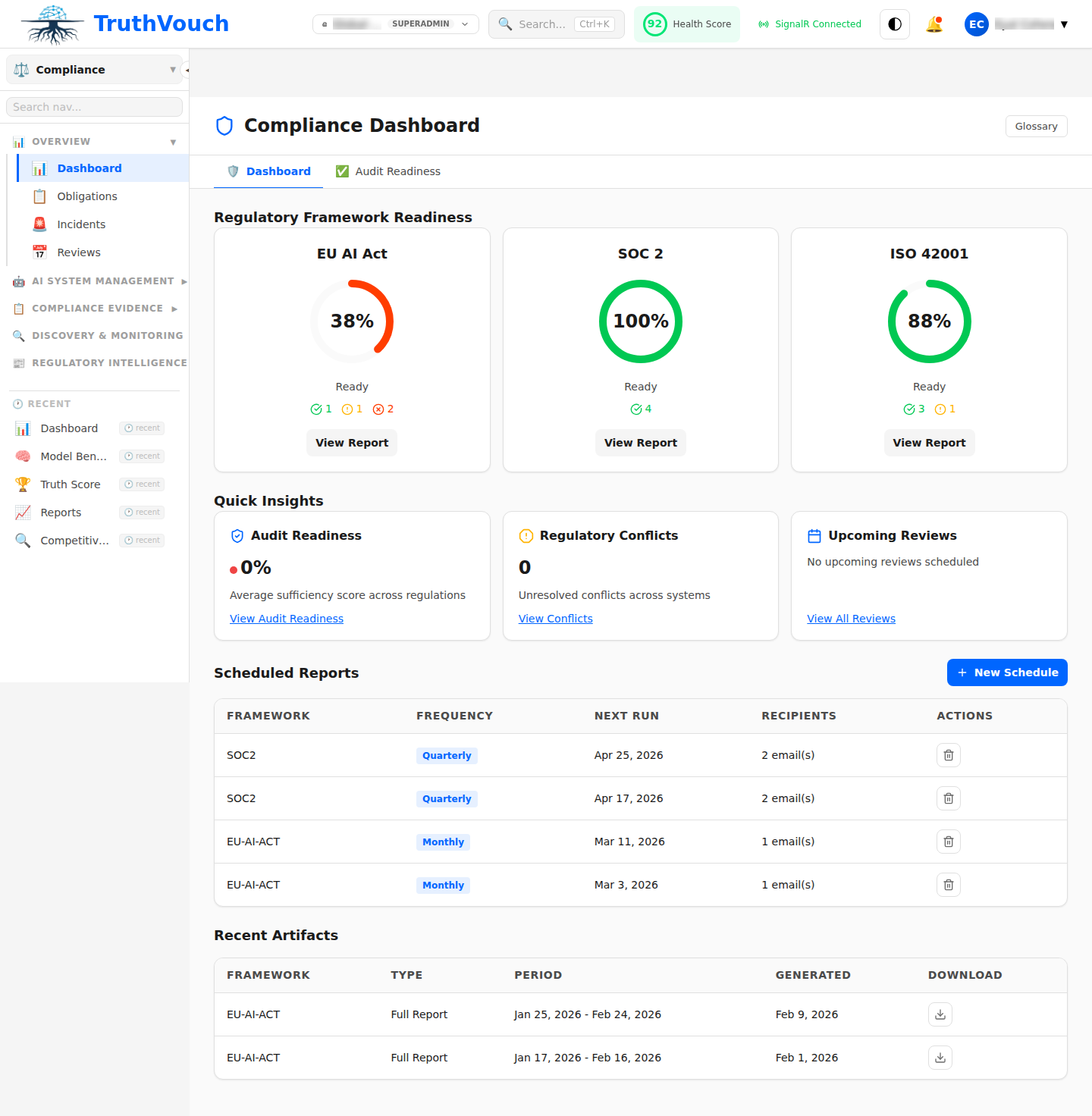
Compliance AI — Main Dashboard
Better Together
Compliance AI works best when combined with these products for complete AI trust coverage.
Common Questions
What does Compliance AI do?
Continuous compliance starting with 5 key frameworks (Professional) and scaling to 50+ regulations across 22 jurisdictions (Business+). Auto-discovers AI systems, generates model cards and Annex IV docs, pulls live control evidence from 16+ connectors, manages training programs, handles EU AI Act Article 73 incident reporting, and typically produces audit-ready reports in under 20 minutes.
How does Compliance AI work?
- 1. Discover AI Systems: Automatically inventory all AI systems in your organization — including shadow AI. Discovery typically surfaces 3–5× more systems than teams self-report.
- 2. Map to Frameworks: Each system is mapped to applicable requirements across 50+ regulatory frameworks spanning 22 jurisdictions — EU AI Act (37 articles), ISO 42001, NIST AI RMF, HIPAA, GDPR, SOC 2, and regulations from the UK, China, Brazil, Canada, Japan, Australia, India, Singapore, South Korea, Saudi Arabia, and the UAE.
- 3. Generate Evidence: Automated evidence collection and audit-ready reports typically generated in under 20 minutes — covering 100% of governed AI traffic with zero manual effort.
Who is Compliance AI for?
Compliance AI is built for Chief Compliance Officer, General Counsel teams that need audit-ready ai compliance in minutes, not months. It is available from the Professional plan at Included in Professional ($1,199/mo).
Compliance AI is available from the Professional plan at Included in Professional ($1,199/mo).
Ready to deploy Compliance AI?
Start with a free assessment to see where it fits in your AI trust journey.